
Hello! Welcome back to my blog!
Today’s blog post is discussing Heidi Huntington’s article, “Subversive Memes: Internet Memes as a Form of Rhetoric”, specifically her claim that “Memes are more than internet humor; research shows them to function by appropriation and resistance to dominant media messages.” This article basically went over how memes can be “decoded” to text using knowledge of the culture it originated in. decoding memes can take a multitude of techniques such as semiotic, discursive, and visual rhetoric approaches.
To be completely honest, I believe that a basic, everyday meme’s main purpose is to be nothing more than just internet humor. I have taken my part in making my own memes and I didn’t think much of anything except if it was going to make my friends laugh. While I do think that a memes main purpose and to be used a dumb humor to distract people from everyday life, I know that memes can be used for more than just humor purposes. I think that depending on who is making the memes, and who their audience is, they can tweak and add details to it to make it say more than just a funny laugh. The only problem with this is that tweaking a meme that is already composed of layers of inside jokes to express a certain idea can become messy. It is hard to find the perfect balance of humor (the original and main use of memes) with purpose without becoming confusing or straying from its original intent (of being both funny and expressing an idea).
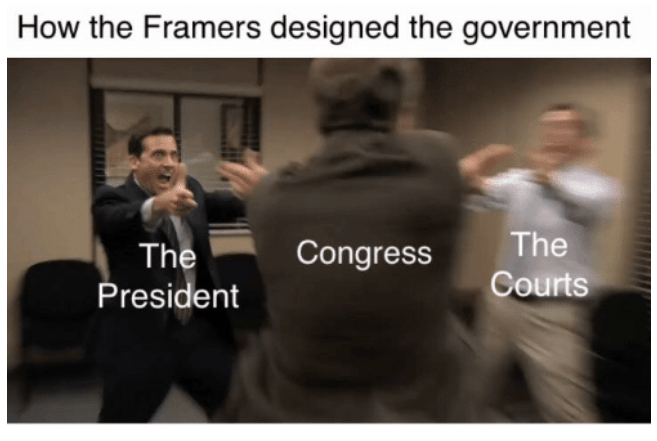
I choose the meme above because I think that it does a fairly good job with integrating an idea into funny visual rhetoric. From first glance I can see the intent to humor the audience (which is most probably for United States citizens), the picture chosen is funny and is well known due to it being from a fairly popular tv show. The good thing about this photo is that although knowing the context of where this picture is taken, it is not necessary to know that it is from The Office in order to think that it is funny. The second detail I notice is that it puts an idea (such as the government not possibly not being that organized or not being well thought out perhaps) and phrases it in a funny way. It puts the idea that the structure of the United States government is a little funny/crazy when thinking about it (having three groups of people decide laws could seem disorganized). Overall, I think memes can be effective in translating messages that are not just to get a laugh from the audience. Complex ideas may be hard to express through this type of media, however, if an author works hard on blending the two ideals (humor and expression of ideas), they can create a meme that can cause an audience to really think about an issue while having a good laugh.
With that I want to leave you with a few questions! Do you think that all memes have a different purpose than just internet humor? Do you think that using memes as a platform to express ideas is effective?
 Caroline Survives and Thrives
Your post did a really good job of explaining Huntington’s article and tying in your own ideas. The meme you chose is very funny and is a great example of a creative meme with purpose. I also like how you asked questions at the end of your blog to encourage participation.
LikeLike